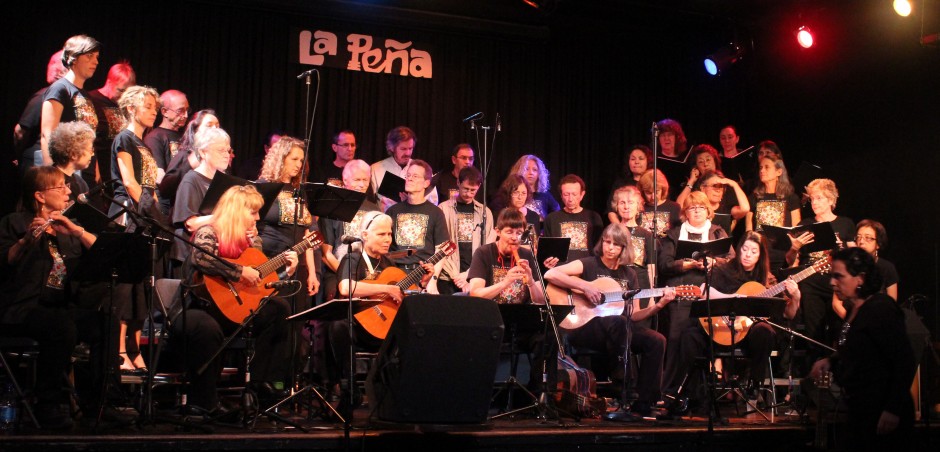
A multigenerational community of singers dedicated to social justice through music.
More…

Founded in 1978 by Chilean refugees and community supporters, La Peña Community Chorus is a multigenerational community of singers dedicated to social justice through music. Rooted in the Chilean exile community that created La Peña Cultural Center in Berkeley, we carry forward a tradition of music that tells the stories of everyday people — their struggles, their resistance, and their hope.
A wealth of talented composers and arrangers have provided original repertoire over the years. The chorus has had many fine directors, including Peter Adler, John Maas, Rafael Manriquez, Lichi Fuentes, and Jan Thyer, who serves as its current director.
Since 1995, when the Chorus was the first U.S. Chorus to participate in an International Choral Festival in Santiago de Cuba, the Chorus has also traveled to Chile, Mexico, Peru, Uruguay, and Argentina, always returning with stories, songs, and images that are largely missing from mainstream news sources.
Several chorus members not only sing, but also play a wide range of instruments to accompany the voices and add to our music’s beauty. Like our music, many of our instruments come from Latin America, including leona, cuatro, charango, quena, cajón, bombo and many more, in addition to instruments of European origin like guitars, flutes and mandolin.
La Peña Community Chorus brings music directly to the people. We have performed at churches, homeless shelters, retirement homes, drug rehab centers, benefits for farm workers, and peace demonstrations and rallies
Wherever we sing, our goal is the same: to build connection, inspire action for peace, justice and solidarity, and keep alive the stories that too often go untold.
Our repertoire, sung mainly in Spanish and English, includes Nueva Canción from Chile and across Latin America – plus, original compositions and arrangements by chorus members and directors.
The New Song Movement (Nueva Canción) began in the late 1950s and 60s in Argentina, Chile, and Uruguay as artists revived folkloric traditions to resist cultural repression. Musicians like Atahualpa Yupanqui and Violeta Parra traveled throughout rural communities, collecting stories, melodies, and instruments that reflected the lives of working people. Their work inspired cultural centers, peñas, and festivals that helped launch a new wave of socially conscious music.
Nueva Canción blended folk traditions with lyrics that spoke directly to injustice, poverty, and human dignity. Artists such as Víctor Jara became global symbols of this movement, writing songs that honored children, workers, and Indigenous communities while denouncing state violence and inequality. Even under censorship and dictatorship, many musicians carried these songs “underground”, preserving the tradition through metaphor, storytelling, and community memory.
Despite repression in Chile during the Pinochet dictatorship, Nueva Canción spread across Latin America, inspiring parallel movements such as Mexico’s Canto Nuevo and Cuba’s Nueva Trova. Artists from Mercedes Sosa to Silvio Rodríguez helped carry this people’s music across borders. Today, Nueva Canción remains rooted in folkloric rhythms and instruments while continuing to give voice to ordinary people, their histories, and their struggles for justice. The songs we sing are a tribute to the people and the traditions of the countries they’re from and in opposition to the abuses and injustices perpetrated by the wealthy and powerful.
You can contact us at [email protected].
If you’re potentially interested in joining the Chorus, we welcome new members, although there may at times be a waitlist. We require auditions before joining.
